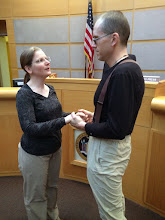
I was twenty-four when I first found out that some people assumed I was gay. I was shocked--not primarily by their misconception, but by their ludicrous reasons: I wore rings, I listened to classical music and I liked flowers.
Fifteen years later, when I began advocating for gay rights, I wanted to identify as straight because I saw the impression it made. Most people expected a straight guy not to know or care about gay rights. In defying that expectation I hoped to make people reframe their view: to see, through my eyes, that my passion should not be remarked upon, let alone rare.
The problem was one of perceived practicality. If people had assumed I was gay for reasons unrelated to sex, how wildly would they misconstrue my advocating for gay rights? And if I attempted to correct them, how quickly would the words "Methinks thou dost protest too much" spring to their minds? I felt that to tell people I was straight would be wasted effort at best, and counterproductive at worst. So for the most part I didn't bother.
And then the other day something embarrasing happened that made me rethink my assumptions. I was telling a co-worker about Chris Kluwe's new book, Beautifully Unique Sparkleponies. He didn't know who Chris Kluwe was, so I told him Kluwe is a famous athlete who had recently come out as gay. But as soon as the words were out of my mouth, I had a feeling that I'd just spread a particular kind of misinformation that I, of all people, had no business spreading.
Sure enough, when I Googled Chris Kluwe, I found that he's a straight athlete who's recently become famous in the gay activist community for his outspoken defense* of gay athletes. Boy, was I embarrassed. I set the record straight (ha) with my co-worker, and decided that I'd been silly in erring on the side of not bothering to let people know I'm straight. After all, if I of all people can mistakenly remember someone as gay just because they're outspoken about gay rights, I shouldn't fault others for making the same mistake, nor should I assume they're any less accepting of correction than I.
So. Ahem.
Chris Kluwe is straight. And so am I.
*If you haven't read his hilarious and incisive "lustful cockmonster" letter, then do so now. Trust me, it's worth reading.
Sunday, July 7, 2013
Thursday, August 2, 2012
There's no such thing as bad publicity.
I spent my childhood lost in my head, exploring woods, fields and cow pastures. I had no sense of the world, no knowledge of politics. I can still reach back and touch the uneasy feelings of bewilderment that arose during my freshman year of college. I gravitated toward liberals, and people certainly saw me as a liberal. But it seemed to me that I was different from everyone else. I was so uninformed that it wasn't accurate to call me a liberal, a conservative, or anything else. I was a blank slate.
I'm not proud of my ignorance. But it provides a valuable perspective. I look at the Chick-fil-A controversy, and I don't see it the way folks on the right or left seem to. All I see is progress.
Gay people were one of the many things that didn't exist in my bucolic childhood world. Kids called other kids "fag" as an insult, and Eddie Murphy made a million dollars every time he said "faggot" during his routine. But I can only remember two instances when my parents spoke about gay people in conversation, and I think neither of them happened until I was in my teens.
One night my family went to dinner at Colosseo's, an Italian restaurant in downtown Oneida. There were two women sitting at the next table, talking loudly enough for the room to hear, about something I didn't understand at the time. It had something to do with "how they were" and how other people reacted to them. I could feel my father's seething irritation. Later I talked to my mother about it--that, or she was flustered enough to talk to me about it--and I got it through my head that they were lesbians, though I didn't know that word at the time.
Later in my teens, there was a lot of media attention given to the behavior of gay men in bathhouses. Ah, that makes sense. That was just about when AIDS was becoming a known quantity. Anyway, one day my mother took me and my sister to the Ponderosa restaurant in New Hartford. Somehow the topic of gay men in bathhouses came up, and my mother said, in her most aghast voice, "Can you imagine?!" Heh. Even at the time, I had some nascent liberal tendencies, because I can remember the reaction I had in my head: "No, Mom, I can't imagine. Why are you trying to?"
I can remember exactly where I was when I first saw two girls holding hands in a way that said "we're not just friends". It was during my freshman year at Cornell, and I was walking along the sidewalk between the ROTC building and the racquetball courts. There were two female students walking along the sidewalk at the northwest corner of Campus Road and Garden Avenue. Yes, I remember it that specifically. It made that much of an impression on me. It expanded my world.
And, not for nothin', lesbians are HAWT.
Where was I? Ah yes. Perspective.
Gay people were not part of my childhood world, and that's the way most folks liked it. The adult world knew they existed, but that existence made them uncomfortable, and they could afford not to recognize it. They got an occasional thrill from talking about gay people in scandalized tones, and since gays were mostly silent or closeted, their words met with little interference from reality. It was a win-win for them.
Yesterday, a whole bunch of adults from small towns across the United States got up, went out their doors, got in their cars, drove to their local Chick-fil-A's, and ordered them some sammiches. They probably smiled and winked at each other and OH MY GOD THAT'S SO GAY! But no, let's be fair... those particular winks were OK, because they communicated a sense of fellowship: a warm, communal assurance that they were fighting the good fight.
But what about their kids? Maybe they were at school. Maybe they were at home, or at the baby sitter. But most of those kids are going to know that mom and/or dad got off their asses and went to Chick-fil-A. Why? Because some queers were trying to shut down the restaurant, and because a bunch of pansy-ass bleeding-heart liberals can't stand to hear a Christian speak the truth.
Now you may rage about that. You may want to go have a protest of your very own on behalf of those kids, because you can't stand to live in a world where they grow up believing those distortions. But I submit to you that those kids are in a much better position than I was at their age.
Trust me when I tell you that average Americans will remain silent about gay people if they can get away with it. How many times have you heard people say that they don't have a problem with gay people as long as they don't "shove it in your face", as though they're being magnanimous in expecting other human beings not to inconvenience them with their existence? They want gays in the closet, because when they're behind that door, they don't exist.
People don't get off their asses for people who don't exist. They get off their asses for real people whom they consider a threat.
Folks, American society has crossed a goddamn Rubicon and no one sees it! People no longer have the option of pretending that gay people don't exist! Of course they're distorting the facts; that's how the human animal reacts to having its world turned upside down!
The fact that all those Americans came out in support of Chik-fil-A is yet another sign that we're winning. They probably don't see it... heck, most gay folks and their allies don't see it. But I've never been more sure of anything. We're winning. So we can afford to have empathy for those folks who lined up yesterday.
I know what you're saying. "Empathy? Why the hell should I have empathy for someone who supports a business that contributes to the deaths of gay people?" Well, ask yourself two questions.
"Can I feel empathy for them?"
"Is it strategically wise for me to feel empathy for them?"
You're the only one who can answer that first question. If the answer is a resounding "No" then I can't blame you.
As for the second question, I feel strongly that the answer is "Yes". Because if you come at those folks with a snarl in your throat and a rictus of self-righteous rage on your face, you'll win nothing but the argument, and lemme tell ya, winning the argument don't do shit. Even if they did listen to you until your throat was sore, they'd see you as nothing but a homunculus: a reinforcement of their image of the shrill, angry, self-loathing liberal who wants to take away their rights as Christians.
Understand that their world has been shattered. Understand that, had you been born into their skin, you might be taking the same actions, saying the same words, as they. Understand that if you comport yourself as a human talking to fellow humans, they will be less able not to see us as real human beings.
Understand that they're losing, and that we're winning. Not only can we afford to be gracious, but it behooves us to be so.
I'm not proud of my ignorance. But it provides a valuable perspective. I look at the Chick-fil-A controversy, and I don't see it the way folks on the right or left seem to. All I see is progress.
Gay people were one of the many things that didn't exist in my bucolic childhood world. Kids called other kids "fag" as an insult, and Eddie Murphy made a million dollars every time he said "faggot" during his routine. But I can only remember two instances when my parents spoke about gay people in conversation, and I think neither of them happened until I was in my teens.
One night my family went to dinner at Colosseo's, an Italian restaurant in downtown Oneida. There were two women sitting at the next table, talking loudly enough for the room to hear, about something I didn't understand at the time. It had something to do with "how they were" and how other people reacted to them. I could feel my father's seething irritation. Later I talked to my mother about it--that, or she was flustered enough to talk to me about it--and I got it through my head that they were lesbians, though I didn't know that word at the time.
Later in my teens, there was a lot of media attention given to the behavior of gay men in bathhouses. Ah, that makes sense. That was just about when AIDS was becoming a known quantity. Anyway, one day my mother took me and my sister to the Ponderosa restaurant in New Hartford. Somehow the topic of gay men in bathhouses came up, and my mother said, in her most aghast voice, "Can you imagine?!" Heh. Even at the time, I had some nascent liberal tendencies, because I can remember the reaction I had in my head: "No, Mom, I can't imagine. Why are you trying to?"
I can remember exactly where I was when I first saw two girls holding hands in a way that said "we're not just friends". It was during my freshman year at Cornell, and I was walking along the sidewalk between the ROTC building and the racquetball courts. There were two female students walking along the sidewalk at the northwest corner of Campus Road and Garden Avenue. Yes, I remember it that specifically. It made that much of an impression on me. It expanded my world.
And, not for nothin', lesbians are HAWT.
Where was I? Ah yes. Perspective.
Gay people were not part of my childhood world, and that's the way most folks liked it. The adult world knew they existed, but that existence made them uncomfortable, and they could afford not to recognize it. They got an occasional thrill from talking about gay people in scandalized tones, and since gays were mostly silent or closeted, their words met with little interference from reality. It was a win-win for them.
Yesterday, a whole bunch of adults from small towns across the United States got up, went out their doors, got in their cars, drove to their local Chick-fil-A's, and ordered them some sammiches. They probably smiled and winked at each other and OH MY GOD THAT'S SO GAY! But no, let's be fair... those particular winks were OK, because they communicated a sense of fellowship: a warm, communal assurance that they were fighting the good fight.
But what about their kids? Maybe they were at school. Maybe they were at home, or at the baby sitter. But most of those kids are going to know that mom and/or dad got off their asses and went to Chick-fil-A. Why? Because some queers were trying to shut down the restaurant, and because a bunch of pansy-ass bleeding-heart liberals can't stand to hear a Christian speak the truth.
Now you may rage about that. You may want to go have a protest of your very own on behalf of those kids, because you can't stand to live in a world where they grow up believing those distortions. But I submit to you that those kids are in a much better position than I was at their age.
Trust me when I tell you that average Americans will remain silent about gay people if they can get away with it. How many times have you heard people say that they don't have a problem with gay people as long as they don't "shove it in your face", as though they're being magnanimous in expecting other human beings not to inconvenience them with their existence? They want gays in the closet, because when they're behind that door, they don't exist.
People don't get off their asses for people who don't exist. They get off their asses for real people whom they consider a threat.
Folks, American society has crossed a goddamn Rubicon and no one sees it! People no longer have the option of pretending that gay people don't exist! Of course they're distorting the facts; that's how the human animal reacts to having its world turned upside down!
The fact that all those Americans came out in support of Chik-fil-A is yet another sign that we're winning. They probably don't see it... heck, most gay folks and their allies don't see it. But I've never been more sure of anything. We're winning. So we can afford to have empathy for those folks who lined up yesterday.
I know what you're saying. "Empathy? Why the hell should I have empathy for someone who supports a business that contributes to the deaths of gay people?" Well, ask yourself two questions.
"Can I feel empathy for them?"
"Is it strategically wise for me to feel empathy for them?"
You're the only one who can answer that first question. If the answer is a resounding "No" then I can't blame you.
As for the second question, I feel strongly that the answer is "Yes". Because if you come at those folks with a snarl in your throat and a rictus of self-righteous rage on your face, you'll win nothing but the argument, and lemme tell ya, winning the argument don't do shit. Even if they did listen to you until your throat was sore, they'd see you as nothing but a homunculus: a reinforcement of their image of the shrill, angry, self-loathing liberal who wants to take away their rights as Christians.
Understand that their world has been shattered. Understand that, had you been born into their skin, you might be taking the same actions, saying the same words, as they. Understand that if you comport yourself as a human talking to fellow humans, they will be less able not to see us as real human beings.
Understand that they're losing, and that we're winning. Not only can we afford to be gracious, but it behooves us to be so.
Sunday, April 10, 2011
Friday, April 8, 2011
Straight Dude. Gay News. Episode 8: Sweetwater Housing Authority
OneNewsNow article "Homosexual influence = 'tyranny of the minority'"
Williams Institute study: "How many people are lesbian, gay, bisexual, and transgender?"
City-Data.com page for Sweetwater with 2009 population count
Queerty article with an image of the letter
Sweetwater boards and commissions meeting locations
Saturday, March 19, 2011
A Perfect Microcosm
I try not to waste my time deconstructing idiocy, but this morning I just can't help myself. The Italian newspaper Il Giornale recently critized the IKEA furniture company for its Italian billboards showing two men holding hands. In a very few sentences, Il Giornale managed to achieve such a high density of puerile self-contradiction that they managed to touch on every reason why I'm a straight ally.Here are the statements from Il Giornale, as reported by the UK Daily Mail.
Il Giornale, the newspaper owned by ruling prime minister Silvio Berlusconi, who has promoted himself as a defender of family values despite his involvement in a series of sex scandals has condemned the advert.For me, the most obvious and galling fallacy is that the billboards constitute an attack, and that the people viewing them are victims. Il Giornale calls them "provocative", a "shock campaign," and... oh, this is wonderful... "Swedish Imperialism"!
It labelled it as 'provocative' and added: ’What's behind all this? It's not awareness of gay rights for gay couples. It's just a brazen marketing strategy.’
The paper went on to say that it was 'not an isolated incident' but a clear attempt at 'Swedish Imperialism' that tried to make everyone equal by having the same 'cheap furniture.'
Il Giornale added:’One has to ask what is the point of such a campaign by IKEA in Catania - it's obvious that they are just trying to get themselves talked about.’
Berlusconi and his ruling People of Freedom Party have long championed family values and aligned themselves with the all-powerful Catholic Church which condemns homosexuality and same-sex relationships.
Il Giornale's website was inundated with outraged comments protesting at what they called a 'shock campaign' but gay rights campaigners in Italy welcomed the advert.
When I think of imperialism, I think of Cromwell, whose heart filled with a Puritanical fire that cleansed Ireland of half its population. I think of the genocidal relocation of native Americans. I think of redcoats bayoneting Indians in that inimitably British way that gave Kipling such a manifest boner. I think of tank treads rolling over village greens, and over dissidents. And I think of IKEA, who erected a vertical piece of paper bearing the image of two men holding hands.
Those bastards!
Ahem. Yes. So, just to be clear: disagreement with me does not constitute an attack on me. Please, everyone, learn this simple rule. Because you will be tested on it. Oh, not by me; don't be silly. No, you'll be tested by your God. Or your gods. Or your lack thereof. We all have it comin', kid.
Now let's move on to the assertions of IKEA's "real" motivations, because they are revealing. Il Giornale says "What's behind all this? It's not awareness of gay rights for gay couples. It's just a brazen marketing strategy... One has to ask what is the point of such a campaign by IKEA in Catania - it's obvious that they are just trying to get themselves talked about."
Wait, what?
Il Giornale, you just said that IKEA was a bunch of "Swedish Imperialists". I imagined their hideously powerful invasion force carrying brown boxes full of ingeniously packed tank parts across the Alps for easy assembly in Italy. And now you're telling me that they're... they're businessmen who are so desperate for revenue that they've resorted to hollow sensationalism? Wait... so who's the victim here? Get your story straight, Il Giornale!
Now, consider the accusation that IKEA does not care about gay couples, but is simply trying to get attention. Do you see the implication? Il Giornale is saying that any "normal" person could not genuinely care about gay couples! In fact, the very fact that IKEA purports to care about gay couples is, to them, proof of their insincerity!
And now we've arrived at the core of why I'm a straight ally.
A while back I talked about my unselfish motivation: GLBT folks represent about ten percent of the human population, and no force in human history ever won out against nine-to-one odds. Therefore GLBT folks need help. They need straight people to stand up and say "I'm no more of a human being than they are."
But I have another motivation -- a selfish one. The folks at Il Giornale are not uncommon. There's a lot of people like them on this planet: people who have been steeped in their religion for so long that the free exchange of ideas is anathema to them. And if they ever get their way, then here's what will happen: they will get rid of the Muslims; they will get rid of the fags; and then I will be the next one up against the fucking wall. Because I have made it publicly known that I do not believe in God. And remember how, to many minds, disagreement constitutes an attack? Yeah. That's the mindset that puts bullets in skulls just like mine.
Thursday, March 10, 2011
Straight Dude. Gay News. Episode 7: Confusion Over Same-Sex Marriage Laws
Original text of SB5
SB5 as passed
Ohioans protest SB 5 to save unions, domestic partner benefits
FYI: Senate Bill 5 DOES NOT redefine marriage in Ohio
Ohio’s Radical Anti-Union Bill Also Has A Hidden Provision To Deny Equal Rights To Same-Sex Couples
Ohio Antilabor Bill Goes Antigay
The Rachel Maddow Show, March 3
Wikipedia article: Same-sex marriage law in the United States by state
Sunday, February 20, 2011
Straight Dude. Gay News. Episode 6: Maryland Marriage Equality
Sources:
Baltimore Sun: Gay marriage legislation filed in General Assembly
Text of SB116
WBAL TV: Some Christians Give OK To Same-Sex Marriage Bill
Equality Maryland: Marriage Equality - One Step Closer!
Baltimore Sun: Gay marriage has the votes to pass state Senate
Baltimore Sun: Gay marriage has the votes to clear Md. Senate
Thursday, January 20, 2011
Meet Stephanie
I’m Stephanie. A mother of two, a massage therapist, and I try really hard to be vegetarian, but sushi is my downfall. I have a couple of chickens in my garden, so I fancy myself a farmer sometimes. I like reading, blogging, watching repeats of Criminal Minds, and I’m bisexual, an avid walker, a sci-fi & fantasy novel buff, and I have a poster of The Nerve and Blood Supply to the Foot next to my computer while I type… no idea why. And that’s a bit about me.Bio: Dr. Stephanie Smith-Browne is the author of “Gothic and the Pacific Voyage.” She studied 18th-century British literature at Princeton and holds degrees in politics and the arts from Columbia. Her work has appeared in the Literature of Travel and Exploration; The Times, London; BBC Radio Arts and Drama; and various poetry and literary journals. A poem from her Cannibal God series was nominated for the Pushcart Prize. She currently writes on bisexuality and lesbian, gay, bisexual and transgender human and civil rights.
Stephanie saw my previous post on Evelyn, and asked to be a face of the day. I was all too happy to oblige. Thanks Stephanie!
Wednesday, January 19, 2011
Meet Evelyn
The year 2010 was a remarkable time in my life to witness an historic event in our American History. On December 22, 2010, I witnessed President Barack Obama sign the most important bill since the Voting Rights Act of 1964. It has been a few weeks, since President Obama repealed Don’t Ask Don’t Tell. This is the beginning a new social transformation of the U.S. Military. My holiday season began with an overwhelming experience. I had the life-changing opportunity to personally shake the president’s hand and hug him-to thank him for supporting “The Forgotten Ones” The Women of Color; the largest population impacted by Don’t Ask Don’t Tell. In the past 8 months, twice I handcuffed myself to the White House fence to bring awareness and attention to the plight of “The Forgotten Ones” The Women of Color. My act of civil disobedience was a fight for equality for the entire lesbian, gay, bisexual, and transgender people that suffered in silence. It was worth risking losing my teaching license-and I would do it all again. I am a servant in God’s Army. I follow the steps of the purest social activist, his name is Jesus Christ and that is to show and demonstrate love for our brothers and sisters. I am honored for this recognition. It comes on the heels of being named one of “The Education Heroes of 2010” and being selected as one of the pictures for “2010 The New York Times 100 Pictures of The Year (Photo 82)”. All I can say is thank you for returning the love.Evelyn Thomas, a veteran of The U. S. Army and U. S. Marine Corps, she is the founder and Executive Director of The Sanctuary Project (www.sanctuaryproject.org). The activist ministry is headquartered at Pilgrim United Church of Christ in Carlsbad, California. This past fall, Post 2 of The Sanctuary Project opened in Texas. She formed the ministry out of the desperate need and failure of The Department of Defense to protect its service members under the Don’t Ask Don’t Tell policy. Ms. Thomas is a licensed secondary educator. Ms. Thomas conducts research in the field of social transformation as the catalyst for legislative reform spearheaded by marginalized populations and the Critical Race Theory as a lens to study homophobia and racism in the public education system. In 2007, she mentored 10 Oceanside High School students to establish the 1st Gay Straight Alliance in the school’s 100 year history. Which was not an easy feat for the students, the school is located outside the gates of Camp Pendleton, California [the largest U.S. Marine Corps base on the west coast] and within North County [which is the “Bible Belt and Conservatism] of San Diego County. In 2009, Ms. Thomas collaborated with the EEO Manager of Human Resources for The City of Oceanside to develop a mandatory Diversity Training Program for all city employees about LGBT issues that may manifest in the work environment. It was the first human resource training to deal with LGBT issues. In 2010, Ms. Thomas developed and implemented the Breaking the Silence training for the Oceanside Unified School District Leadership Team-to guide administrators and teachers to develop the foundation, knowledge, skills, and strategies to better serve the LGBT students, parents, staff and faculty. Her book, Does Butch Nappy Hair Offend You? One Teacher’s Struggle for Acceptance in the Professional World of Education was published in May 2006 by the California State University, San Marcos Press, The Road to the White House [a short essay] was published in May 2010 by the San Diego Gay & Lesbian News, authored curriculum for Civics Education Voices of Change: The American Creed: Freedom of Expression, The Color of My World, etc... and in November 2010, Ms. Thomas participated in the U.S. Marine Corps Writer’s Forum in New York City presenting “The Red Scarf”: a short story of a African-American Transgender Servicemember.
Education: California State University San Marcose
Master of Arts in Education: Teaching, Learning, and Leadership, 2006
Social Science Credential, Cross-Cultural Language and Academic Development February 2003
Bachelor of Science: Business Administration: Service Sector, 1999
Professional
74th Assembly District San Diego County Central Committee Representative
Social Science Educator
Founder and Executive Director, The Sanctuary Project AKA The Sanctuary Project Veterans
Chief Executive Officer, The Thomas Systems Associates
GetEqual Provisional Board Member
North County Women’s Democratic Club Treasurer
Professional Writer
I know Evelyn through Facebook, and when she asked to be a face of the day I was happy to oblige. Thanks Evelyn!
Monday, January 17, 2011
The Metaphor Trap
Lately I've been running into a lot of metaphors relating to LGBT rights. I tend to think in metaphor, so when I see someone using one to support a point with which I disagree, I can't resist deconstructing it and turning it back on itself. I find it satisfying -- so satisfying that I'm coming to see it as counterproductive. Please bear with me as I explain why. I promise to come out the other side of this with something useful to all of us as activists.
I few weeks ago, Johanna Maria Rose posted the following.
I love it too much.
Reducing political arguments to attractive metaphors may make people on my side smile and agree with me, but it's almost certainly not going to help me convert anyone. More importantly, it plays into the hands of my opponents. People who are against LGBT rights win by reducing people to one of two abstract concepts: a joke or a threat. And what is metaphor but abstraction?
So from now on I think I'm going to resist the pull of the metaphorical argument. From now on I'm going to refuse to talk in terms of abstractions. When someone starts talking peanut butter and jelly sandwiches, I'm going to cut them off, saying "We're not talking about peanut butter and jelly sandwiches. We're talking about people." The same goes for apples and oranges, or circles. We must refuse to allow the abstraction of a human being.
Not convinced? Don't think it's reasonable to dismiss those cute, punchy metaphors? Well, don't believe me. Just ask Plato. He was all up in that metaphor shit. Here's a summary of the Platonic conception of the elements from a page about da Vinci's Platonic solids.
Folks, just because the metaphor seems to fit perfectly... it's still just a metaphor. People are people. Nothing more, nothing less. So don't get sucked in. If anyone tries to reduce a person to an apple or an orange, let them know the error of their ways. Tell 'em they fail as hard as Plato.
I few weeks ago, Johanna Maria Rose posted the following.
So let me get this straight... Larry King is on his 8th divorce, Elizabeth Taylor is possibly getting married for a 9th time, Britney Spears had a 55-hour marriage, Jesse James and Tiger Woods, while married, were having sex with everyone; and yet the idea of same-sex marriage is still going to destroy the institution of marriage? Really? Repost to your page if you agree - Proud to!Gary Sibio disagreed.
Your argument is flawed. It's akin to arguing that the piano isn't a musical instrument because it sounds awful when a three-year-old bangs on it or a cat walks across it. Marriage, by definition, involves a man and a woman. It is not a relationship created by the government so the government has no authority to redefine it.Here's my reply.
Gary I love the idea of new pairs of hands playing piano duets. It's an apt analogy because marriage, like the long line of instruments from which the piano arose, is an evolving concept. A piano bears as much resemblance to a harpsichord as the twentieth century notion of marriage does to its eighteenth century incarnation.After failing to respond to me, and arguing with a few other people, Gary said
And after the government establishes "gay marriage" it can start to work on the square circle.Again I turned Gary's metaphor on itself.
Well Gary, as straw men go, it ain't bad for a first try. It smells like sour grapes, which is good, 'cause ain't no crow gonna come near it. But it's awful flimsy lookin'. If a crow with no sense of smell comes along, or hell, a good stiff breeze, then that sucker's gonna be in the dirt! Speakin' o' which, here comes one now.Then, last week, Laura Kanter posted a link to the Washington Post article Gay marriage isn't revolutionary. It's just the next step in marriage's evolution. Dennis Leight asked what I thought was a very important, and irresistible, question.
There is no circle. A circle has never existed and will never exist. A circle is an imaginary concept -- what Plato called a "form". In our "sensible world" we can draw circles, but these will never be more than imperfect reflections of that perfect and eternal circle.
Societies have been drawing their imperfect circles since there have been societies, and each society's circle has looked a little different from all the others. But I'd bet that wherever and whenever a circle has been drawn, there's been someone squawkin' about his circle bein' the only circle.
I've heard some people say "why does a peanut butter and jelly sandwich need to evolve?" What can you say to those people?Here are the various responses I made.
- Ain't nothin' illegal about eatin' a big thick peanut butter sandwich.
- Should people who don't like peanut butter and jelly sandwiches be forced to eat peanut butter and jelly sandwiches?
- Peanut butter and jelly sandwiches don't have to evolve. But they will evolve. It's only the people here, now, who assume that peanut butter and jelly sandwiches will never evolve. Just like people from every historical epoch assumed that their favorite food was the pinnacle of something or other. It's normal, human, chronological myopia: the demonstrably false assumption that if I did it this way, and my father did it this way, and my grandfather did it this way, then by golly that's the way it's always been done. It's not true. It's never been true. But people have always believed it to be true.
- A peanut butter and jelly sandwich is an evolving construct. The thing that comes to mind when you say "peanut butter and jelly sandwich" bears little resemblance to what someone just a few generations ago would have thought of upon hearing those same words. You think that an amalgamation of partially hydrogenated corn oil, bleached flour, cane sugar and added salt is a peanut butter and jelly sandwich because that's what the intersection of our particular culture and economic forces have settled on. But someone from fifty years ago would take one bite and spit it into the trash can.
The things with which we choose to fill our lives are constructs. Constructs evolve. Inevitably. Children take comfort from sameness. Can't we, as adults, take comfort from the consistency of unsameness?
While it is one thing "creating laws so that people don't feel persecuted," the cardinal explained, "don't create a law that says apples are oranges." For a lawmaker to do so, George added, he "betrays his vocation to pass good law," especially problematic for a "Catholic lawmaker."This prompted the following from me.
Again with the food metaphors. He says "don't pass a law saying that apples are oranges". Fine, we won't. But what does that have to do with the issue at hand? I'll tell you what: apples and oranges were each made by this universe's tendency to spawn complex, self-replicating systems... or by God, if that's what you believe. Whatever. The point is that apples are as they should be, and oranges are as they should be. Likewise, straight people and gay people are as they should be. Would you try to make orange juice from apples? No? Fine. Then don't pretend that gay people don't exist, and don't deny them the right to marry the people whom they love. Simple.I love playing with language. I love the challenge not only of taking apart the metaphor and revealing its flaws, but of making from the pieces a more robust machine that serves my own purposes. I love the idea of smiling in the face of the person from whom I took the metaphor, and thanking them for helping me make my point.
It seems to me like Cardinal George wasn't being honest in his metaphors. If he was, he would've said "don't pass a law saying that rotten apples are apples". If he believes that gay people are defective, he should be clear about that and deal with the consequences.
I love it too much.
Reducing political arguments to attractive metaphors may make people on my side smile and agree with me, but it's almost certainly not going to help me convert anyone. More importantly, it plays into the hands of my opponents. People who are against LGBT rights win by reducing people to one of two abstract concepts: a joke or a threat. And what is metaphor but abstraction?
So from now on I think I'm going to resist the pull of the metaphorical argument. From now on I'm going to refuse to talk in terms of abstractions. When someone starts talking peanut butter and jelly sandwiches, I'm going to cut them off, saying "We're not talking about peanut butter and jelly sandwiches. We're talking about people." The same goes for apples and oranges, or circles. We must refuse to allow the abstraction of a human being.
Not convinced? Don't think it's reasonable to dismiss those cute, punchy metaphors? Well, don't believe me. Just ask Plato. He was all up in that metaphor shit. Here's a summary of the Platonic conception of the elements from a page about da Vinci's Platonic solids.
Plato conceived the four classical elements as atoms with the geometrical shapes of four of the five platonic solids... This concept linked fire with the tetrahedron, earth with the cube, air with the octahedron and water with the icosahedron. There was intuitive justification for these associations: the heat of fire feels sharp and stabbing (like little tetrahedra). Air is made of the octahedron; its minuscule components are so smooth that one can barely feel it. Water, the icosahedron, flows out of one's hand when picked up, as if it is made of tiny little balls. By contrast, a highly un-spherical solid, the hexahedron (cube) represents earth. These clumsy little solids cause dirt to crumble and breaks when picked up, in stark difference to the smooth flow of water.Yeah. Uh huh. We all know how well that "pointy fire particles" theory withstood the test of time.
Folks, just because the metaphor seems to fit perfectly... it's still just a metaphor. People are people. Nothing more, nothing less. So don't get sucked in. If anyone tries to reduce a person to an apple or an orange, let them know the error of their ways. Tell 'em they fail as hard as Plato.
Wednesday, December 22, 2010
I'm a side-sleeper.
Tonight something came to me. Now, I wouldn't go so far as to say that, in order for this particular something to come to me, I had to be drunk. Nor would I say that my having run into an ex-friend in Wal-Mart earlier this evening -- a friend with whom I had a particularly painful falling-out last week -- was requisite to this particular insight. And I would be the last one to suggest that talking to a delightful trio of lesbians on Facebook was a necessary mental catalyst for the insight. I'm just saying that, for me, all these factors seem to have helped.
How many hours per day do you spend having sex?
No. It's not a prurient question. Really. Trust me.
How many hours per day do you spend having sex? I would guess that even the most sexually heroic of us could not lay (ha!) claim to having sex more than three hours per day. That's three hours average out of every twenty-four. Feel free to call me on that. No, really. You needn't feel guilty about making me feel like a doddering old bastard. I'll just sit here in the dark with my ham sandwich...
Anyway. Just for the sake of argument, let's say that anyone who has to work for a living is probably not spending more than three hours out of any given twenty-four having sex.
How many hours per night do you sleep?
Even the craziest fucker I ever met slept sometimes. Even people like Winston Churchill took catnaps that totaled to at least a few hours out of every temporal diurnal anomaly. Even the people who make me think "Damn, how the hell can they do that?" sleep around four or five hours per night. Which leads me to conclude that...
Even the most sleep-deprived person spends more time sleeping than he spends having sex.
So that means...
I could ask you "Are you straight, gay, bisexual, other?"
...and the answer to that question would have less bearing on your life than the following question.
"Are you a side-sleeper, back-sleeper, or stomach-sleeper?"
How many hours per day do you spend having sex?
No. It's not a prurient question. Really. Trust me.
How many hours per day do you spend having sex? I would guess that even the most sexually heroic of us could not lay (ha!) claim to having sex more than three hours per day. That's three hours average out of every twenty-four. Feel free to call me on that. No, really. You needn't feel guilty about making me feel like a doddering old bastard. I'll just sit here in the dark with my ham sandwich...
Anyway. Just for the sake of argument, let's say that anyone who has to work for a living is probably not spending more than three hours out of any given twenty-four having sex.
How many hours per night do you sleep?
Even the craziest fucker I ever met slept sometimes. Even people like Winston Churchill took catnaps that totaled to at least a few hours out of every temporal diurnal anomaly. Even the people who make me think "Damn, how the hell can they do that?" sleep around four or five hours per night. Which leads me to conclude that...
Even the most sleep-deprived person spends more time sleeping than he spends having sex.
So that means...
I could ask you "Are you straight, gay, bisexual, other?"
...and the answer to that question would have less bearing on your life than the following question.
"Are you a side-sleeper, back-sleeper, or stomach-sleeper?"
Saturday, December 11, 2010
Wednesday, December 8, 2010
Alterité
Since my conversation with my sister, I've been thinking a lot about trying to understand people who don't share my views about bendy folk. I suppose that's why I made such an unexpected connection last night.
I was listening to Professor Jeremy McInerney lecturing* about Greece in the aftermath of the Persian Wars of the fifth century B.C. My ears perked up when he started talking about how the Greeks defined themselves in relation to their enemies.
McInerney makes the point that, prior to the Persian Wars, not even the Greeks living within the Persian Empire saw the Persians as alien. There are records of Persian rulers of Greeks in Persian territory who worshiped the local Greek gods. Greeks served at the Persian court. Greek craftsmen went, happily, to work on Persian projects.
But then, during the Persian wars, the Greek attitude seems to have shifted. They came to see the Persians as effete, effeminate easterners. War had transformed their neighbors into The Other. In defining themselves, they had taken everything they thought about themselves and projected its mirror image onto their enemies. Some historians call this process alterité.
This all struck me as a possible answer to my question "Why on earth are people -- especially people who aren't even religious -- so uncomfortable with gay folks? What difference does it make?" Perhaps the answer is "They need to strongly define themselves, and this definition includes the assignment of an opposite."
But here's the question that has always maddened me: "Why the U.S.?" Why are we, of all people, so bothered by gays? In our short history we've prided ourselves in giving the finger to authority while we give a voice to the individual citizen. Of all people, shouldn't we be the ones to proclaim that a person's sexuality has nothing to do with his worth?
Well, let's look at us in relation to the Greeks. According to the theory of alterité, the Greeks needed to define themselves in response to war. That sure sounds familiar. World War II filled America's head with visions of its Greatest Generation. Since then the American man has had one heck of an image to live up to. To fulfill this need, did he also require someone to be everything the American man wasn't?
Then, long before the guns were cool, the Russians stepped in and gave us a whopping big boogeyman: a mirror in which we saw our dark opposite. Again the American man had a foil against which to define himself and a source of paranoia. Did this make him look around himself for his antithesis?
And in the midst of all this, some of the biggest civil rights movements in history arose. Liberals became more visible and organized. New media technology showed the world images of the military being called in to enforce desegregation laws. Liberal and conservative had a new arena in which each gleefully saw in the other an evil homunculus. Did this solidify the image of the gay as everything the Real American wasn't?
"What does it mean to be an American?" Aside from the years immediately following the American Revolution, I imagine that the years since World War II have been those in which Americans have most desperately needed to answer that question.
Does our fear of gay people stem from a need to define ourselves?
That question is not academic. It bears on my work as an ally. If the answer is "Yes" then the nature of that work becomes much more clear: my job is to break down the illusion of The Other. My job is to show people that The Other is us.
*Here is a transcription of the relevant sections from Professor McInerny's lectures.
One last aspect of the modern treatment of the Greeks we need to address is that over the last two centuries, as the modern nation states of England, Germany, France, and the US, have taken shape, moving out of being earlier kingdoms or constituting themselves are republics, they developed national identities as all nations have at some point. This is created out of a duel process of a consideration of what we once were, of our past, and of what the other cultures and civilizations are around us, the ones we deal with. This is the process often referred to as alterité, where we look at another culture or civilization and see in it the opposite of ourselves. We take our values and abstract the negative onto the other.
Now in the course of this century we've certainly seen that in the way that we in the western world have looked at the Soviet Union as it one was, and now that it's gone we have much different feelings about the Russians. Yet we thought of that world as being in some sense, our diametric opposite. More generally speaking, there's been a strong notion that we, all in the west, western Europe and the English-speaking world, North America, are somehow different from the east.
This has been a product of our colonial experience and history, and has meant we've had to think of ourselves somehow as being culturally quite distinct. Part of that process of identifying what we are, as opposed to what they are, has been to think about our past and what we come from. So the whole enterprise of studying the ancient world has really often been tainted by this notion of finding some kind of cultural superiority in the west, a superiority of our way of doing things. Whereas the east could point to Confucian philosophy, the aesthetic accomplishments of China or Japan, the western version of this has been to go back to our Classical roots.
...
More importantly, not only is Greece relatively insignificant in terms of the whole expanse of the Persian Empire, this I think is really significant: there were many Greeks living and working in the Persian Empire, and who did not think of the Persians as being a completely foreign and alien people who were the exact opposite of them. We know that, for example, as Persian power increased, and as they called upon stonemasons to build their extraordinary palaces, they were importing Greeks from Ionia, who were working quite happily in the Persian Empire. We know Greeks who were actually living at the court of the great king, working for him, recording, acting as doctors for the great king and so forth.
So I think that it is a great mistake to think that, at the time that the Greeks and the Persians first came into contact, there was an immediate sense that the two were destined to a final confrontation. That's a view that is dictated by subsequent events. But in fact at the time I think the world must have looked very different indeed.
...
The victory of the Athenians, the Spartans, and the rest of the Greeks, had enormous consequences for the Greeks themselves. It's from this time onwards, really, that we find the Greeks more fully articulating a sense of their Greek identity as opposed to another identity. In this case, the Persians playing the role of The Other. You may remember in a very early lecture in this series we talked about the notion of alterité, of defining onesself in relation to another culture. From this time on, the Persians will play that role for the Greeks, as that alien other culture. In fact one very good book written on the Greeks of the fifth century is called The Mirror of Herodotus, claiming that when Herodotus looked at the Persians he was really looking, in a sense, in a mirror, seeing the negative reflection of what the Greeks liked to see in themselves.
Consequences of this victory were wide-ranging and far-reaching. It is from this time, for example, that we find the Greeks in their political discourse often using the term "eleutheria", meaning "freedom". It's quite clear that the victory of the Greeks over the Persians resulted in them more clearly articulating in their own minds the idea of what freedom entailed. And so the characteristic notion of Greek freedom, that takes root at this time, is that it is the freedom of a community to exist autonomously -- free of the influence of an outside power. And this remained a powerful idea throughout the rest of Greek history and remains a powerful idea and an interpretation of freedom even today.
I was listening to Professor Jeremy McInerney lecturing* about Greece in the aftermath of the Persian Wars of the fifth century B.C. My ears perked up when he started talking about how the Greeks defined themselves in relation to their enemies.
McInerney makes the point that, prior to the Persian Wars, not even the Greeks living within the Persian Empire saw the Persians as alien. There are records of Persian rulers of Greeks in Persian territory who worshiped the local Greek gods. Greeks served at the Persian court. Greek craftsmen went, happily, to work on Persian projects.
But then, during the Persian wars, the Greek attitude seems to have shifted. They came to see the Persians as effete, effeminate easterners. War had transformed their neighbors into The Other. In defining themselves, they had taken everything they thought about themselves and projected its mirror image onto their enemies. Some historians call this process alterité.
This all struck me as a possible answer to my question "Why on earth are people -- especially people who aren't even religious -- so uncomfortable with gay folks? What difference does it make?" Perhaps the answer is "They need to strongly define themselves, and this definition includes the assignment of an opposite."
But here's the question that has always maddened me: "Why the U.S.?" Why are we, of all people, so bothered by gays? In our short history we've prided ourselves in giving the finger to authority while we give a voice to the individual citizen. Of all people, shouldn't we be the ones to proclaim that a person's sexuality has nothing to do with his worth?
Well, let's look at us in relation to the Greeks. According to the theory of alterité, the Greeks needed to define themselves in response to war. That sure sounds familiar. World War II filled America's head with visions of its Greatest Generation. Since then the American man has had one heck of an image to live up to. To fulfill this need, did he also require someone to be everything the American man wasn't?
Then, long before the guns were cool, the Russians stepped in and gave us a whopping big boogeyman: a mirror in which we saw our dark opposite. Again the American man had a foil against which to define himself and a source of paranoia. Did this make him look around himself for his antithesis?
And in the midst of all this, some of the biggest civil rights movements in history arose. Liberals became more visible and organized. New media technology showed the world images of the military being called in to enforce desegregation laws. Liberal and conservative had a new arena in which each gleefully saw in the other an evil homunculus. Did this solidify the image of the gay as everything the Real American wasn't?
"What does it mean to be an American?" Aside from the years immediately following the American Revolution, I imagine that the years since World War II have been those in which Americans have most desperately needed to answer that question.
Does our fear of gay people stem from a need to define ourselves?
That question is not academic. It bears on my work as an ally. If the answer is "Yes" then the nature of that work becomes much more clear: my job is to break down the illusion of The Other. My job is to show people that The Other is us.
*Here is a transcription of the relevant sections from Professor McInerny's lectures.
One last aspect of the modern treatment of the Greeks we need to address is that over the last two centuries, as the modern nation states of England, Germany, France, and the US, have taken shape, moving out of being earlier kingdoms or constituting themselves are republics, they developed national identities as all nations have at some point. This is created out of a duel process of a consideration of what we once were, of our past, and of what the other cultures and civilizations are around us, the ones we deal with. This is the process often referred to as alterité, where we look at another culture or civilization and see in it the opposite of ourselves. We take our values and abstract the negative onto the other.
Now in the course of this century we've certainly seen that in the way that we in the western world have looked at the Soviet Union as it one was, and now that it's gone we have much different feelings about the Russians. Yet we thought of that world as being in some sense, our diametric opposite. More generally speaking, there's been a strong notion that we, all in the west, western Europe and the English-speaking world, North America, are somehow different from the east.
This has been a product of our colonial experience and history, and has meant we've had to think of ourselves somehow as being culturally quite distinct. Part of that process of identifying what we are, as opposed to what they are, has been to think about our past and what we come from. So the whole enterprise of studying the ancient world has really often been tainted by this notion of finding some kind of cultural superiority in the west, a superiority of our way of doing things. Whereas the east could point to Confucian philosophy, the aesthetic accomplishments of China or Japan, the western version of this has been to go back to our Classical roots.
...
More importantly, not only is Greece relatively insignificant in terms of the whole expanse of the Persian Empire, this I think is really significant: there were many Greeks living and working in the Persian Empire, and who did not think of the Persians as being a completely foreign and alien people who were the exact opposite of them. We know that, for example, as Persian power increased, and as they called upon stonemasons to build their extraordinary palaces, they were importing Greeks from Ionia, who were working quite happily in the Persian Empire. We know Greeks who were actually living at the court of the great king, working for him, recording, acting as doctors for the great king and so forth.
So I think that it is a great mistake to think that, at the time that the Greeks and the Persians first came into contact, there was an immediate sense that the two were destined to a final confrontation. That's a view that is dictated by subsequent events. But in fact at the time I think the world must have looked very different indeed.
...
The victory of the Athenians, the Spartans, and the rest of the Greeks, had enormous consequences for the Greeks themselves. It's from this time onwards, really, that we find the Greeks more fully articulating a sense of their Greek identity as opposed to another identity. In this case, the Persians playing the role of The Other. You may remember in a very early lecture in this series we talked about the notion of alterité, of defining onesself in relation to another culture. From this time on, the Persians will play that role for the Greeks, as that alien other culture. In fact one very good book written on the Greeks of the fifth century is called The Mirror of Herodotus, claiming that when Herodotus looked at the Persians he was really looking, in a sense, in a mirror, seeing the negative reflection of what the Greeks liked to see in themselves.
Consequences of this victory were wide-ranging and far-reaching. It is from this time, for example, that we find the Greeks in their political discourse often using the term "eleutheria", meaning "freedom". It's quite clear that the victory of the Greeks over the Persians resulted in them more clearly articulating in their own minds the idea of what freedom entailed. And so the characteristic notion of Greek freedom, that takes root at this time, is that it is the freedom of a community to exist autonomously -- free of the influence of an outside power. And this remained a powerful idea throughout the rest of Greek history and remains a powerful idea and an interpretation of freedom even today.
An ignoble question for my bendy friends
My argument with my sister caused me a lot of pain. But my reaction to the pain actually felt worse than the pain itself, because I saw something in myself that I didn't like.
In talking to my sister I felt like I was communing with the ugliest aspects of my family. There's my uncle Frank, sitting around the table loudly proclaiming that "Wherever there are niggers in the world, there's trouble." There's my uncle Stanley sitting within arm's reach of my nephew and niece, saying something nasty about black people, in a house where I'm not supposed to say the word "gay" in front of those same children.
And there's everyone in my whole family talking to anyone but the person they need to talk to. Did person A piss you off? Well then, bitch to person B or C about it, but never talk directly to person A. And if you should actually talk to person A, make damned sure that you don't bitch about what you're really mad about. Bitch about something else. If we actually addressed our problems we might solve them, and where would we be without our anger and resentment?
This is how my sister had reacted to me. And what did I do? I went ahead and followed the same damned pattern. And when I finally let out my feelings, it was like popping a balloon: I don't seem capable of just letting a little of the air out; no, I have to let it all out in a big explosion.
In the midst of all this pain, I had a desire. I wanted to say to my gay friends "Can I have a pat on the head?" I wanted them to know what I'd done. I wanted some recognition, some appreciation, some love that would dull the pain.
That desire is beneath me. It defies everything I believe about morality: that I do what is right because it's right, regardless of whether anyone is watching. A moral act done with the thought of any reward whatsoever ceases to be a moral act and becomes nothing but service rendered for payment.
Yet I want it. I feel small and... smaller than any creature that could even warrant the word "ugly". But I want it. So I have to ask...
Is it OK that I want a pat on the head?
In talking to my sister I felt like I was communing with the ugliest aspects of my family. There's my uncle Frank, sitting around the table loudly proclaiming that "Wherever there are niggers in the world, there's trouble." There's my uncle Stanley sitting within arm's reach of my nephew and niece, saying something nasty about black people, in a house where I'm not supposed to say the word "gay" in front of those same children.
And there's everyone in my whole family talking to anyone but the person they need to talk to. Did person A piss you off? Well then, bitch to person B or C about it, but never talk directly to person A. And if you should actually talk to person A, make damned sure that you don't bitch about what you're really mad about. Bitch about something else. If we actually addressed our problems we might solve them, and where would we be without our anger and resentment?
This is how my sister had reacted to me. And what did I do? I went ahead and followed the same damned pattern. And when I finally let out my feelings, it was like popping a balloon: I don't seem capable of just letting a little of the air out; no, I have to let it all out in a big explosion.
In the midst of all this pain, I had a desire. I wanted to say to my gay friends "Can I have a pat on the head?" I wanted them to know what I'd done. I wanted some recognition, some appreciation, some love that would dull the pain.
That desire is beneath me. It defies everything I believe about morality: that I do what is right because it's right, regardless of whether anyone is watching. A moral act done with the thought of any reward whatsoever ceases to be a moral act and becomes nothing but service rendered for payment.
Yet I want it. I feel small and... smaller than any creature that could even warrant the word "ugly". But I want it. So I have to ask...
Is it OK that I want a pat on the head?
The Abyss Revisited
I've been feeling bad since around Thanksgiving, when I had a troubling argument with my sister while visiting the family home. It wouldn't hurt so much if the argument had been about what happened that day. But it was about something that happened over a year ago.
Last year at about this time I wrote about how my sister shushed me for saying the word "gay" in front of her children. At the time, I got furious because I felt that I finally understood her previously incomprehensible behavior: she didn't actually disagree with my activism because, as she said, "[gay people] may not want your help"; the truth was that she didn't like gay people, and she didn't want me helping them.
So for a year I've been more distant, not talking to her about it because I felt like she hadn't been straight with me. Yeah, I know. Not the most productive behavior.
So when my bottled-up resentment came out, it came out big -- and it got bigger. Because when I first mentioned my anger over her shushing me, she rounded on me, expressing her anger that I would say "that word" in front of her children. I was so furious that I wanted to say to her "You're mad at me? Well, guess what? My mad is bigger than yours!"
So I started out by saying "You want me to pretend that gay people don't exist? Well, I guess I'd better not let them know that niggers exist, either, huh?" She sputtered in shock that I would make the comparison, so eventually I switched tactics. I said "OK, how about albinos? Should I pretend that albinos don't exist? What's the difference?"
My sister kept sputtering about how albinos look physically different, but with gay people it's a sexual preference. And I kept cutting her off, driving home the point that I was not talking about sex. This point is critical to me, because I feel that the primary argument against exposing children to the notion of same-sex couples is absurd. People say that for children to read a book about Timmy's two daddies is to bring sex into the classroom. Nonsense. I say -- and I kept saying to my sister -- that if you claim that the book about Timmy's daddies is sexual, then you have to say that a book about Jane's mommy and daddy is also sexual.
Well, long story short: I told my sister that there are hundreds of ways in which I will defer to her judgment in my interactions with her children, but I will not pretend that my gay friends don't exist. I said that I don't feel that she gets to edit my conversation to that extent. She said that she thinks she does. I replied that I would not bring any agenda to a conversation to her children, but if my friend Mel and her girlfriend should happen to come up in a conversation, I would mention them. And then it would be her choice whether she wanted to cut off my contact with them.
I was enraged and indignant and frustrated that night. My frustration arose mainly from my inability to articulate the distinction between those ways in which I will defer to my sister's judgment, and that one way in which I wont. The distinction is there. It's real. I can see it in my mind's eye, and yet... I can't articulate it to myself, let alone my sister.
I feel that the closest I've come is this: My niece and nephew do not deserve an uncle who is so craven as to desert his friends. They deserve an uncle who would never pretend that his friends don't exist. And I'm going to give them that uncle, or nothing at all. That's why I feel perfectly comfortable with telling her that if she doesn't like it, she can keep me from seeing them.
During the following days my anger faded, and I was able to feel my pain more and more. I wished that I'd brought up the topic earlier so that my anger wouldn't have had a chance to fester. Maybe then I wouldn't have left feeling like I'd just had a deeply encysted wound lanced. Maybe then I wouldn't have felt bad about castigating my sister for something that happened a year ago.
Then, once I was able to think more clearly, a new thought came to me: I missed a big opportunity. Since I became an ally and an advocate, I've known that it's my job to listen to people who disagree with me, because if no one listens then nothing gets accomplished. Only when one party makes the effort to genuinely engage with the other can a dialectic begin.
I let my anger get the better of me, and I unloaded all my self-righteous rage onto my sister. And in so doing I missed a big opportunity. After all, if I can't calmly listen to my sister, whom can I listen to?
So. Next time I have some time alone with my sister, I'm going to calmly ask her to talk to my about why she feels the way she feels. Until I do that, I can't hope to understand it.
Last year at about this time I wrote about how my sister shushed me for saying the word "gay" in front of her children. At the time, I got furious because I felt that I finally understood her previously incomprehensible behavior: she didn't actually disagree with my activism because, as she said, "[gay people] may not want your help"; the truth was that she didn't like gay people, and she didn't want me helping them.
So for a year I've been more distant, not talking to her about it because I felt like she hadn't been straight with me. Yeah, I know. Not the most productive behavior.
So when my bottled-up resentment came out, it came out big -- and it got bigger. Because when I first mentioned my anger over her shushing me, she rounded on me, expressing her anger that I would say "that word" in front of her children. I was so furious that I wanted to say to her "You're mad at me? Well, guess what? My mad is bigger than yours!"
So I started out by saying "You want me to pretend that gay people don't exist? Well, I guess I'd better not let them know that niggers exist, either, huh?" She sputtered in shock that I would make the comparison, so eventually I switched tactics. I said "OK, how about albinos? Should I pretend that albinos don't exist? What's the difference?"
My sister kept sputtering about how albinos look physically different, but with gay people it's a sexual preference. And I kept cutting her off, driving home the point that I was not talking about sex. This point is critical to me, because I feel that the primary argument against exposing children to the notion of same-sex couples is absurd. People say that for children to read a book about Timmy's two daddies is to bring sex into the classroom. Nonsense. I say -- and I kept saying to my sister -- that if you claim that the book about Timmy's daddies is sexual, then you have to say that a book about Jane's mommy and daddy is also sexual.
Well, long story short: I told my sister that there are hundreds of ways in which I will defer to her judgment in my interactions with her children, but I will not pretend that my gay friends don't exist. I said that I don't feel that she gets to edit my conversation to that extent. She said that she thinks she does. I replied that I would not bring any agenda to a conversation to her children, but if my friend Mel and her girlfriend should happen to come up in a conversation, I would mention them. And then it would be her choice whether she wanted to cut off my contact with them.
I was enraged and indignant and frustrated that night. My frustration arose mainly from my inability to articulate the distinction between those ways in which I will defer to my sister's judgment, and that one way in which I wont. The distinction is there. It's real. I can see it in my mind's eye, and yet... I can't articulate it to myself, let alone my sister.
I feel that the closest I've come is this: My niece and nephew do not deserve an uncle who is so craven as to desert his friends. They deserve an uncle who would never pretend that his friends don't exist. And I'm going to give them that uncle, or nothing at all. That's why I feel perfectly comfortable with telling her that if she doesn't like it, she can keep me from seeing them.
During the following days my anger faded, and I was able to feel my pain more and more. I wished that I'd brought up the topic earlier so that my anger wouldn't have had a chance to fester. Maybe then I wouldn't have left feeling like I'd just had a deeply encysted wound lanced. Maybe then I wouldn't have felt bad about castigating my sister for something that happened a year ago.
Then, once I was able to think more clearly, a new thought came to me: I missed a big opportunity. Since I became an ally and an advocate, I've known that it's my job to listen to people who disagree with me, because if no one listens then nothing gets accomplished. Only when one party makes the effort to genuinely engage with the other can a dialectic begin.
I let my anger get the better of me, and I unloaded all my self-righteous rage onto my sister. And in so doing I missed a big opportunity. After all, if I can't calmly listen to my sister, whom can I listen to?
So. Next time I have some time alone with my sister, I'm going to calmly ask her to talk to my about why she feels the way she feels. Until I do that, I can't hope to understand it.
Thursday, April 8, 2010
Meet Teke
On Good Friday 1984 my life ended as I knew it to be. No more going to my upper middle class school. No more hanging out, no more anything.My church, my father, and everyone in our little town found out the horrible truth about me. On this day....I had to learn things that are never talked about in a classroom. I had to learn quick.
I learned how to hide my face when the beating began.
I learned that ten minutes was not enough time to "Get your shit and get the fuck out of here, FAGGOT!!"
I learned over twenty years would pass and still no family.
I learned a fifteen year old boy is a commodity.
I learned not to vomit in my mouth while old men trembled with exitment as they touched me.
I learned to get the money up front.
I learned what time certain fast food places threw leftovers into dumpsters.
I learned to steal.
I learned the police do not think gay boys can be raped,beaten, and left in a pool of their own blood and piss to die.
I learned......that I had actualy ASKED for that to happen to me.
I learned to carry a gun.
I learned.........to use it!
I learned God had not turned his back on me, its just that he was helping some one with more pressing issues.
I learned that sleeping under a river bridge at night was when I felt the most scared,alone, and very vulnerable.
I learned what the barrel of a gun taste like.
I learned that bullets will not work after they have been wet a few times.
I learned to hate my self.
I learned that this was all my fault for letting my hormones rage out of controll and wanting to kiss another boy.
This was all so many years ago, I have forgotton or blocked many things. I still get jealous when I here of kids with accepting family and friends. I am glad for them at the same time. Maybe some day, no gay kids will have to suffer for it. I know I was actualy one of the lucky unlucky kids.....
I learned........to survive!
I met Teke through Twitter and have enjoyed his YouTube videos ever since. Teke will be happy to know that, as I post this, I am tipsy from the two pints of Franziskaner that I just had at my local watering hole. Thanks Teke!
Sunday, March 28, 2010
Meet Jacqui
I'm a Canadian living in Ireland with my wife -- we married in Canada almost 5 years ago -- and our cats & dog. I work in retail and blog in my spare time. My blog (BigGayCloset.com) is a collection of stories and news stories related to coming out, aimed at providing gay people with a sense of community, and a place where questioning people can find stories they can relate to.I'm addicted to news and politics. I love debating the issues of the day, and adore quiet pubs where conversation is possible. A good beer and a great argument make my day.
My parents were both very involved in politics from local to national -- my father is a conservative and my mother a liberal -- so I learned to enjoy politics as a game as much as it is a serious thing. I find nothing more exciting than staying up all night watching election results roll in, regardless of who is winning.
I studied percussion (that's drums and other stuff you hit) in university, but eventually dropped out when I realised I was gay. It all hit me pretty hard, and when a friend offered a chance to run away to England for a year, I took her up on it.
I ended up in Ireland, and fell in love.It's hard to believe that just loving someone changes everything, but it does.
I've been chatting with Jacqui on Twitter and was quite pleasantly surprised to get an e-mail from her tonight with her face of the day submission. Thanks Jacqui!
Meandering Manifesto, Part 4: Stability
This is part four of my Meandering Manifesto series.
Last year, Grace and I went to a second wedding in Michigan. It was much more pleasant than the first one. This time the priest didn't say anything that made me apoplectic with rage. But he did say something that got me thinking.
He began with a statistic that something like one in two marriages end in divorce, then worked his way down a line of increasing religious context of the marriage. I don't remember the following numbers exactly, but that's not the point.
As a left-leaning agnostic this made me squirm a bit. Those numbers made me uncomfortable. I found myself wanting to read up on the research to see if they were skewed.
Later, I realized that the degree of accuracy didn't matter. Because whether those numbers were spot on, or off by an order of magnitude, there's no doubt in my mind that he's right.
He's right.
A religiously involved marriage brings stability to the married couple and to their society.
Just stop for a minute. Don't react. Just breathe.
Now. Hear what I'm saying. We are adults. Not only can we hold contradictory ideas in our heads, we can also parse wildly disparate ideas that at first seem as inseparable as the hydrogen and oxygen atoms in water.
We can admit that folks on the other side of the political divide are right to call the bathwater dirty. That admission in no way implies that we favor throwing out the baby.
I admit that religion, marriage, and the potent combination thereof bring stability to our society. I do not, however, agree that the stable structure that we gain is worth the cost. I believe that the foundation stones of that structure rest on the backs of my gay, lesbian, bisexual, and transgender friends.
Stability always demands unity. Unity always eschews variance. People don't like what is different. Communities and societies and countries develop a collective animus against the unusual. This animus may well have served a vital purpose in primitive marginal communities which could have gone extinct if members had strayed from the norm. But today we are no longer primitive, or so we flatter ourselves. Today our hard-wired animus against sex and gender variance is out of all proportion to any conceivable harm that such variance could cause.
Traditional religious marriages bring valuable stability to my country, my community, and my life. I admit that freely.
And I don't care.
I don't want that much stability. I don't want stability at the cost of hatred. I don't want a life so stable that, while I'm hiking with my good friend Mel, we have to worry that someone might overhear her talking about her girlfriend. I'm not so ravening after peace and quiet that I want Vikrant to be anything less than himself, because I find Vikrant's himself to be quite a delightful one. And I sure as hell ain't willing to pretend that another person's sex life is any of my damned business, let alone that it could somehow threaten my wobbly-ass secular marriage.
Keep your stability. It's covered in blood and lies. My hands ain't the cleanest, but I'll be damned if I'll dip 'em in shit.
Last year, Grace and I went to a second wedding in Michigan. It was much more pleasant than the first one. This time the priest didn't say anything that made me apoplectic with rage. But he did say something that got me thinking.
He began with a statistic that something like one in two marriages end in divorce, then worked his way down a line of increasing religious context of the marriage. I don't remember the following numbers exactly, but that's not the point.
- Of the couples who were married in a church ceremony, about one in fifty get divorced.
- Of the couples who were married in a church ceremony and who attend church regularly, one in several hundred get divorced.
- Of the couples who were married in a church ceremony, who attend church regularly, and who pray together at home, one in about twelve hundred get divorced.
As a left-leaning agnostic this made me squirm a bit. Those numbers made me uncomfortable. I found myself wanting to read up on the research to see if they were skewed.
Later, I realized that the degree of accuracy didn't matter. Because whether those numbers were spot on, or off by an order of magnitude, there's no doubt in my mind that he's right.
He's right.
A religiously involved marriage brings stability to the married couple and to their society.
Just stop for a minute. Don't react. Just breathe.
Now. Hear what I'm saying. We are adults. Not only can we hold contradictory ideas in our heads, we can also parse wildly disparate ideas that at first seem as inseparable as the hydrogen and oxygen atoms in water.
We can admit that folks on the other side of the political divide are right to call the bathwater dirty. That admission in no way implies that we favor throwing out the baby.
I admit that religion, marriage, and the potent combination thereof bring stability to our society. I do not, however, agree that the stable structure that we gain is worth the cost. I believe that the foundation stones of that structure rest on the backs of my gay, lesbian, bisexual, and transgender friends.
Stability always demands unity. Unity always eschews variance. People don't like what is different. Communities and societies and countries develop a collective animus against the unusual. This animus may well have served a vital purpose in primitive marginal communities which could have gone extinct if members had strayed from the norm. But today we are no longer primitive, or so we flatter ourselves. Today our hard-wired animus against sex and gender variance is out of all proportion to any conceivable harm that such variance could cause.
Traditional religious marriages bring valuable stability to my country, my community, and my life. I admit that freely.
And I don't care.
I don't want that much stability. I don't want stability at the cost of hatred. I don't want a life so stable that, while I'm hiking with my good friend Mel, we have to worry that someone might overhear her talking about her girlfriend. I'm not so ravening after peace and quiet that I want Vikrant to be anything less than himself, because I find Vikrant's himself to be quite a delightful one. And I sure as hell ain't willing to pretend that another person's sex life is any of my damned business, let alone that it could somehow threaten my wobbly-ass secular marriage.
Keep your stability. It's covered in blood and lies. My hands ain't the cleanest, but I'll be damned if I'll dip 'em in shit.
Subscribe to:
Posts (Atom)